
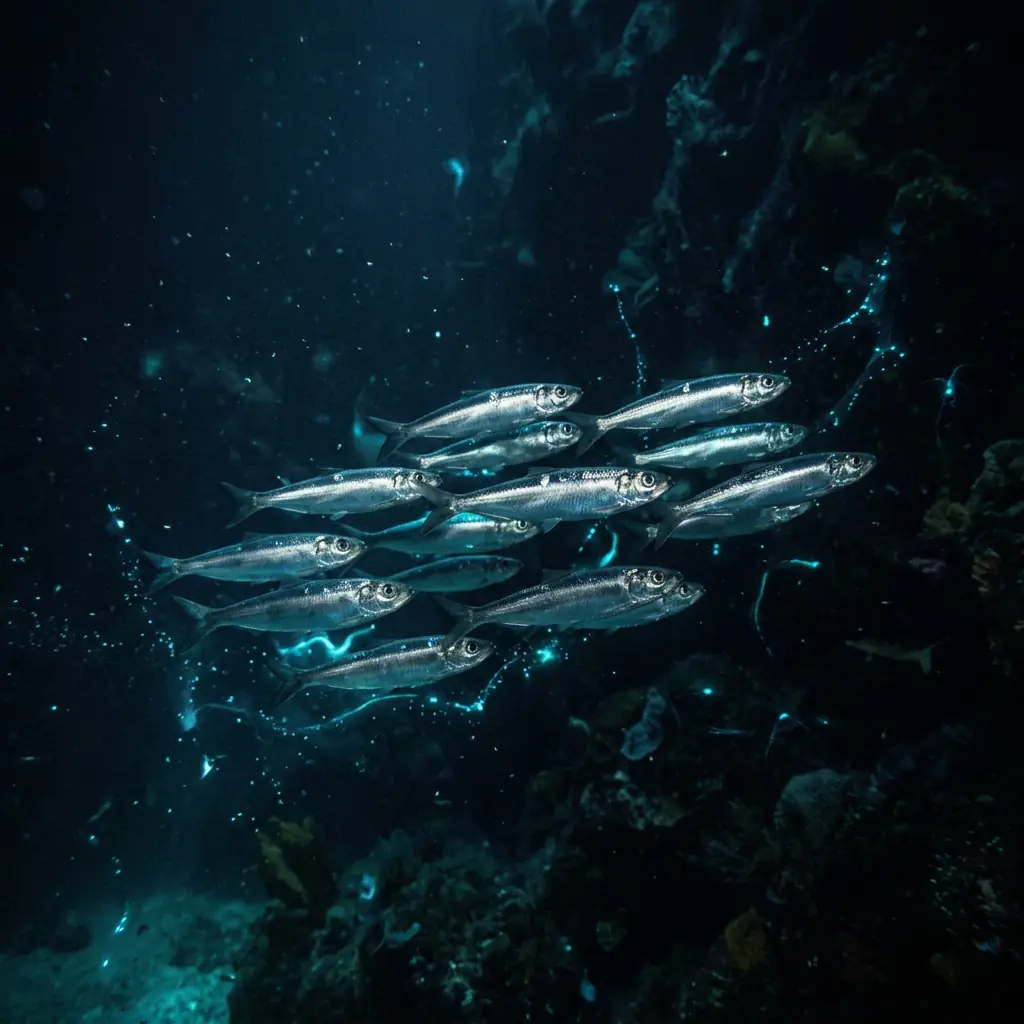
Clupea harengus, the Atlantic herring, is the most numerically abundant vertebrate in the North Atlantic. A single school may contain three to four billion individuals. They travel in a shoal that can span several cubic kilometers of open water — yet individual herring are among the least distinguishable fish alive. No marking, no coloration, no feature separates one from another. They are interchangeable by design.
This is the herring's survival strategy: not camouflage, not speed, not armor — but the mathematical impossibility of being singled out. When a predator enters a school, the school performs the bait ball maneuver — a tight, rotating sphere of fish so dense and uniform that no targeting is possible. The predator strikes repeatedly; statistically, most fish survive. The few that do not are the cost of the defense of the many. The school's integrity persists.